Overview
Maximum load capacity from minimum material
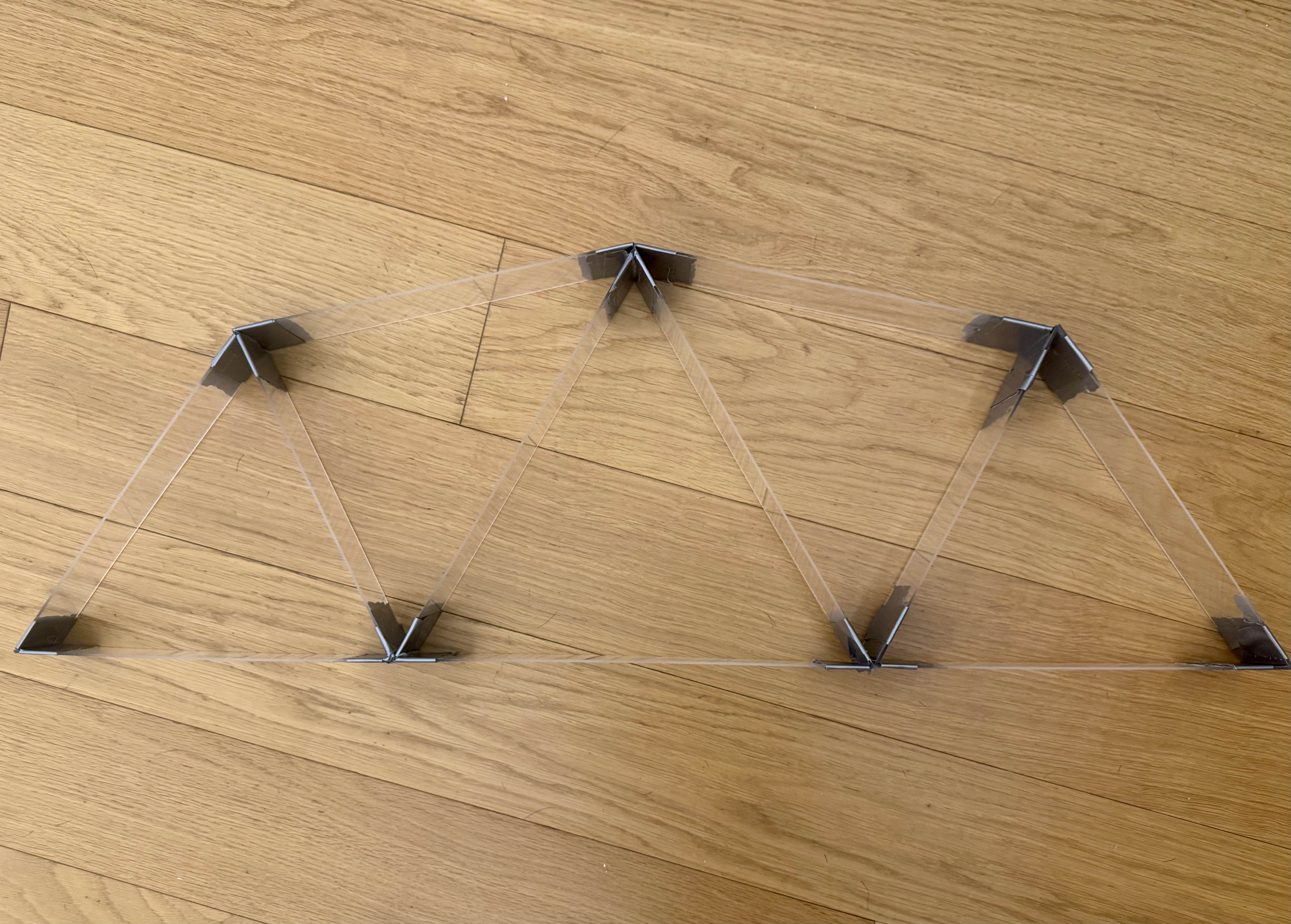
Given a fixed budget of acrylic strip material, a set of permitted joint configurations and quantitative specifications, the challenge was to design a truss that maximizes the load it can hold before catastrophic failure and to do so through the development and use of a MATLAB program to aid in analysis.
This project demanded close integration between computational modeling and physical intuition. The final structure supported 55.38 oz, exceeding the optimized prediction of 53.07 oz and minimum load requirement. The MATLAB model created correctly identified which member would buckle first under increasing load.
Methodology
Structural modeling & iterative geometry refinement
I implemented a full 2D truss force analysis program in MATLAB, assembling the global stiffness matrix to extract internal member forces under a unit load. Member forces were extracted under a unit applied load, then scaled to predict failure loads using Euler buckling theory for the compression members and tensile limits for members in tension.
The initial design predicted a capacity of 38 oz. Through geometric iteration and adjusting joint positions, I identified that shallow-angle compression diagonals were causing instability through high slenderness ratios. Steepening those critical members and reducing their lengths led to an 40% increase in predicted load capacity to 53.07oz.
Results
Model validated by physical test
- Initial design predicted 38 oz capacity; optimized design predicted 53.07 oz
- Final physical structure held 55.38 oz - 4.4% above prediction
- Critical buckling member correctly identified by MATLAB model prior to testing
- 40% load capacity improvement achieved through geometric optimization alone
- Model accuracy sufficient for engineering design confidence