Overview
Real-time seizure prevention through adaptive optics
Photosensitive epilepsy (PSE) affects roughly 3–5% of those with epilepsy. Individuals with PSE face a genuine neurological threat in which ordinary flickering light sources, screens, and strobe patterns cause significant seizure risk. Existing solutions are passive (tinted lenses) and offer no real-time adaptation. This project sets out to change that. Central to this mission is ensuring the device remains accessible and affordable to the populations who need it most.
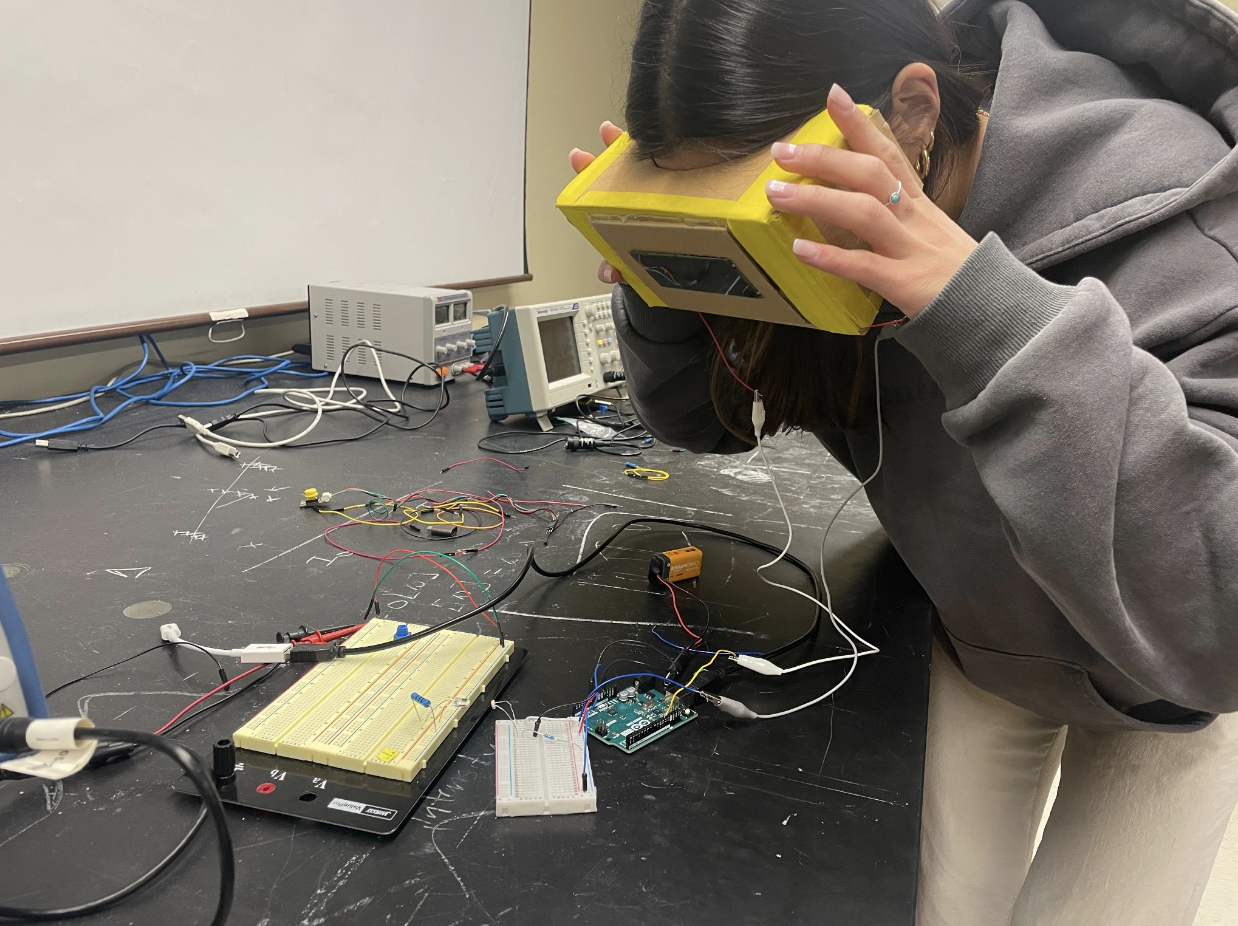
Working in continuation of a Neuroscience Design Lab course, I am developing voltage-controlled smart eyewear capable of dynamically attenuating light stimuli in the 3–30 Hz range, the primary trigger band for photosensitive seizures, and do so in under 10 ms, fast enough to prevent the neural cascade before it begins.
Technical Approach
Sensing, processing, and response
The system integrates three core layers. A light sensor monitors ambient light fluctuation frequencies, sending data to an Arduino microcontroller. A custom firmware pipeline performs real-time frequency analysis: if detected flicker falls within the seizure-provoking band, the controller triggers lens opacity modulation within a single display frame. Complementing this, PPG sensors placed at the temple continuously monitor the user's physiological vitals, such as heart rate and blood oxygen levels, providing an additional data stream to track the user's condition in real time.
Outcomes
Validation & next steps
- Prototype validated attenuation of 3–30 Hz stimuli using controllable LED flicker test bench
- Firmware achieves sub-10 ms detection-to-response latency on Arduino Uno
- Comparative analysis of LCD, LCoS, and electrochromic lenses documented for next design iteration
- Ongoing: moving toward flexible PCB integration and ergonomic frame design
- Goal: develop market-acceptable proof-of-concept model to attract funding and bring this device one step closer to the population in need